Bringing Commercial Print In-House: The Business Case for UAE Enterprises
4 min read
In most large organizations across Dubai and Abu Dhabi—multinational regional headquarters, law firms, private school networks, property developers, and healthcare operators—printing follows a familiar pattern: everyday office documents run on floor-standing multifunction copiers (MFPs), while marketing brochures, training binders, event programs, and confidential tender packs are sent out to commercial print agencies.
For small volumes, this division makes sense. But as an organization grows, external print invoices quietly escalate. When accounts payable audits reveal AED 15,000 to AED 50,000 leaving the business each month in third-party print fees, CFOs and procurement directors begin asking a straightforward question: Does it make financial and operational sense to bring high-volume production printing in-house?
The financial tipping point: If your organization consistently spends AED 15,000 or more per month on outsourced print, an in-house light production press (such as the Ricoh Pro C5300s series) typically achieves full cost recovery within 12 to 18 months, while providing same-morning turnaround and airtight data confidentiality.
The True Costs of Outsourcing Print
When comparing vendor invoices against internal equipment costs, organizations often look only at the headline rate per brochure. That ignores three substantial indirect costs:
1. Turnaround Lag and Rush Penalties
Commercial print shops operate on queue schedules. A standard brochure or report run typically takes 3 to 5 business days from file approval to courier delivery. When an executive team requires 150 bound presentation books for an unscheduled board meeting or tender defense the next morning, agencies apply 50% to 100% emergency rush surcharges—or decline the job entirely.
2. Confidentiality and Regulatory Compliance
Tender proposals, merger and acquisition documentation, quarterly unreleased financial results, and legal trial bundles contain highly sensitive corporate data. Uploading PDF files to third-party commercial print shops or transferring files over non-secure channels introduces unnecessary data security and non-disclosure liability. In-plant printing keeps proprietary documentation strictly behind your corporate firewall.
3. Waste from Over-Ordering
To secure acceptable unit pricing from commercial printers, procurement teams frequently order 2,500 or 5,000 copies of collateral when only 600 are actually needed. Months later, branding updates, regulatory revisions, or executive staff changes render the surplus obsolete. Stored reams of outdated brochures ultimately end up in recycling bins.
The Equipment Bridge: Light Production Presses
The common misconception among corporate facility managers is that a production press is a multi-ton industrial machine requiring three-phase industrial power, chemical wash stations, and dedicated press operators. While heavy commercial presses do require that environment, modern light-production cut-sheet engines—exemplified by the Ricoh Pro C5300s and Pro C5310s—are engineered specifically for corporate and institutional in-plant environments:
Compact Footprint: Designed to fit comfortably in a dedicated corporate mailroom, reprographics suite, or design studio.
Standard Electrical Infrastructure: Operates on standard commercial electrical feeds rather than requiring high-amperage three-phase industrial drops.
Broad Media Support: Feeds up to 360 gsm coated stock, embossed card, linen stationery, and synthetic waterproof sheets without jamming.
Automated Inline Finishing: Equippable with modular booklet makers that automatically fold, saddle-stitch, and face-trim multi-page documents, outputting square-back professional booklets ready for client presentation.
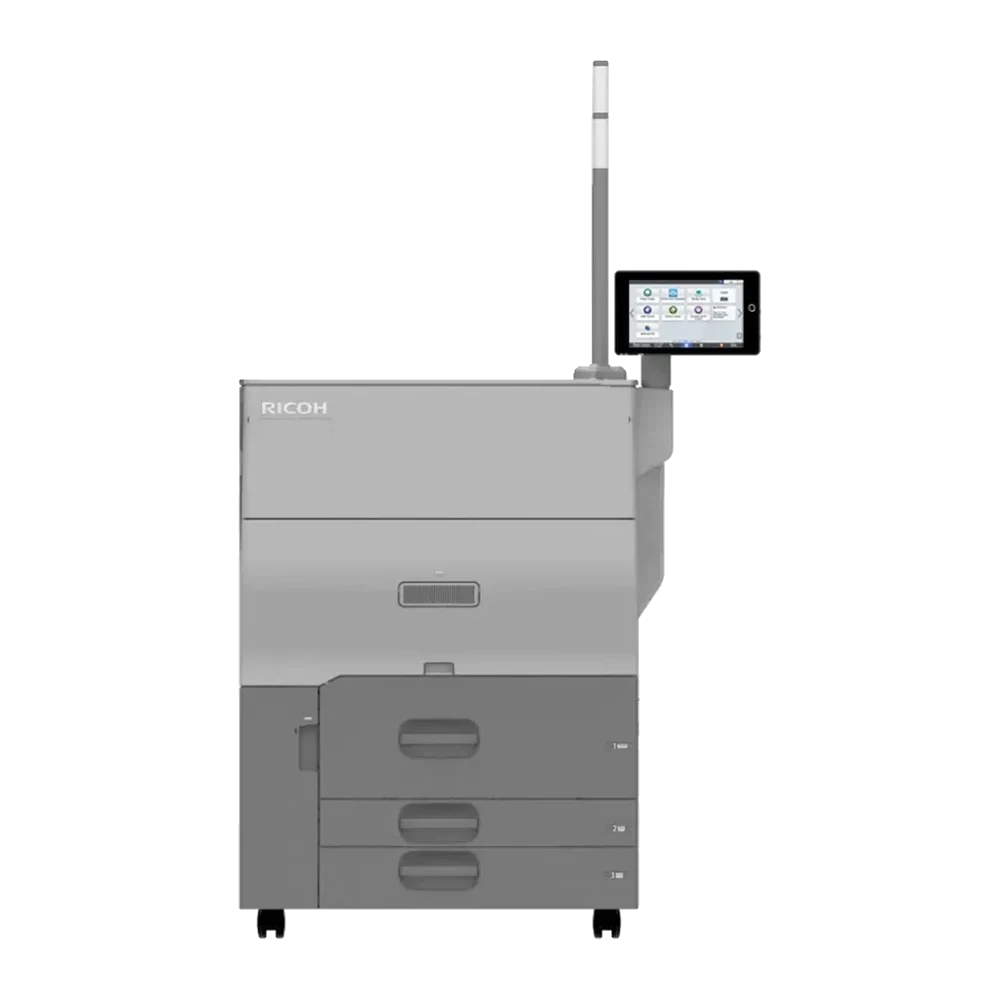
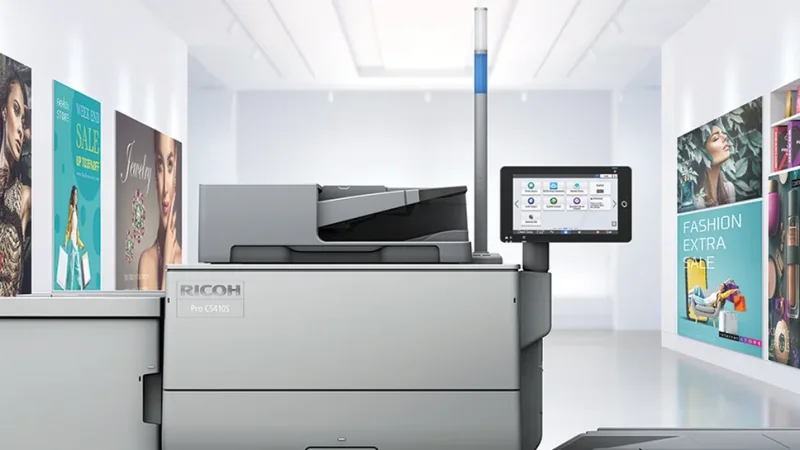
In-plant corporate press: The Ricoh Pro C5400s series provides commercial cut-sheet print resolution and media handling up to 360 gsm in a compact footprint engineered for corporate reprographics rooms and single-phase electrical lines. (Equipment photo: Ricoh production hardware).
How to Calculate Your Internal ROI
To determine whether your volume justifies an in-house production setup, assemble a three-year Total Cost of Ownership (TCO) ledger across four columns:
Hardware Acquisition / Lease: Monthly amortisation or operating lease for the engine, Digital Front End (DFE), and required finishing modules.
Managed Service / Click Contract: A comprehensive Managed Print agreement covering black-and-white and colour clicks, genuine toners, drums, fuser units, and on-site maintenance engineers.
Paper Media: Bulk-purchased commercial digital paper stocks, cardboards, and binding supplies.
Operator Allocation: Factoring the time of an existing office administrator, design specialist, or facility technician who oversees the queue.
Sum those four internal line items and compare them against your trailing twelve-month average of external print vendor invoices. In most UAE corporate facilities printing upwards of 25,000 colour pages monthly, the internal cost per page is between 40% and 65% lower than retail outsourced billing.
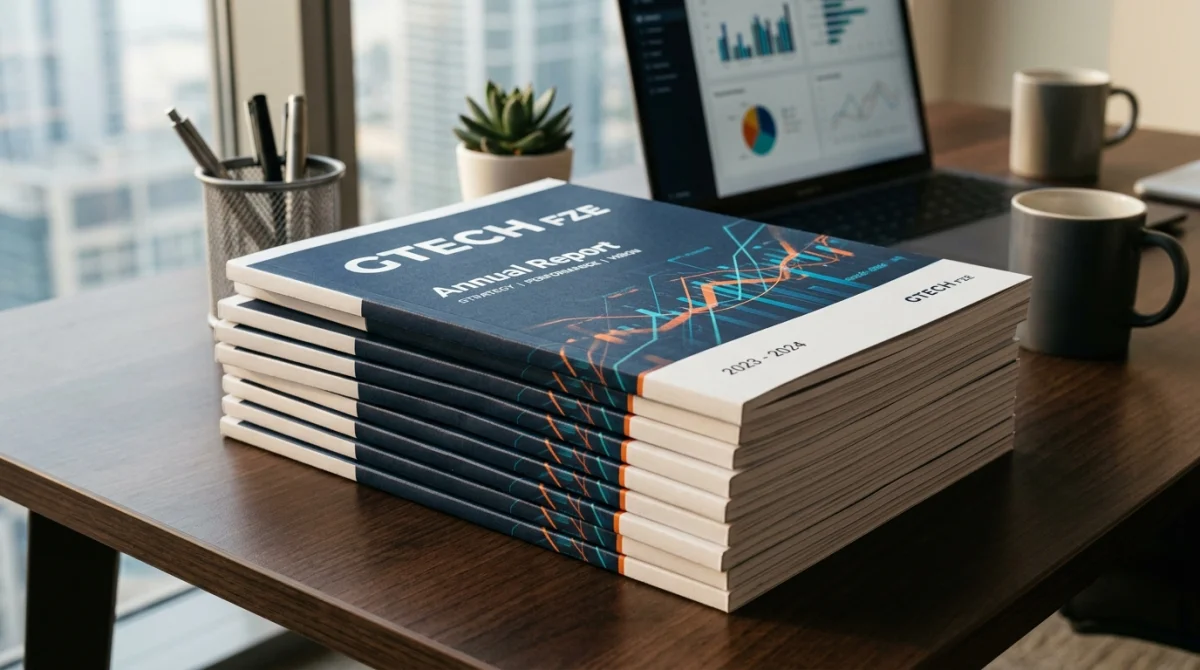
Professional in-house publication: Gtech FZE annual reports and corporate strategy booklets produced with automated inline saddle-stitch binding and face trimming, providing immediate turnaround for executive and tender presentations.
When Outsourcing Remains the Right Choice
Bringing production in-house is not a universal mandate for every job. External commercial print houses remain the superior option for:
Massive volume runs exceeding 50,000 identical sheets where long-run offset web presses dominate on raw per-sheet economy.
Unusual hard-bound book casing, foil stamping, or specialized custom die-cutting requiring heavy industrial post-press machinery.
Out-of-home (OOH) giant building wraps, exhibition booth fabrication, and vehicle fleet livery.
For everything in between—short-run marketing brochures, conference guides, training workbooks, tenders, and product catalogs—an in-plant digital production press gives UAE enterprises complete control over quality, deadlines, and operational costs. View our cut-sheet production systems, read about our managed print services, or contact our procurement consultants for a complimentary print-volume assessment.
Disclaimer: Financial calculations, payback periods, and operational comparisons presented in this article serve as general procurement guidelines. Actual return on investment depends on your specific monthly page volumes, colour saturation ratios, selected equipment finishing configurations, media specifications, and contractual terms. Technical equipment data reflects manufacturer published specifications at publication date. Request a comprehensive print audit from Gtech FZE for tailored commercial analysis.
Questions
Frequently asked
At what monthly outsourcing spend does an in-house production press make sense?
In the UAE market, organizations consistently spending AED 15,000 to AED 20,000 or more per month on outsourced commercial print generally find that a light-production cut-sheet press (such as the Ricoh Pro C5300s series) delivers full cost recovery within 12 to 18 months through significantly lower unit page costs.
Does a light production press require three-phase industrial power?
No. Light production cut-sheet engines like the Ricoh Pro C5300s / C5310s operate on standard commercial single-phase 220–240V power lines, making them suitable for corporate mailrooms, reprographics rooms, and design studios without expensive electrical substation upgrades.
Can an in-house press produce professional finished booklets?
Yes. Modular inline finishing units can automatically fold, saddle-stitch, and face-trim multi-page documents, producing square-back professional booklets, training workbooks, and corporate prospectuses without requiring manual collation or third-party bindery work.
What print jobs should still be outsourced to commercial print shops?
External commercial printers remain the best choice for massive volume runs exceeding 50,000 copies (where offset web presses dominate on per-unit cost), specialized hard-cover book casing, intricate foil stamping, and outdoor oversized signage or vehicle wraps.
Talk to us
Want this applied to your own setup?
We are an authorized Ricoh distributor holding stock at Jebel Ali, supporting installations across the UAE and exporting into the wider region. Tell us your volumes and we will tell you what fits.
At 300 copies digital wins outright on cost and turnaround. At 15,000 offset wins on unit economics. Between those two figures lies the crossover point that determines print shop margins across Dubai and the UAE.
Standard 4-colour digital printing has become a race to the bottom on price. A 5th colour station—running white, clear gloss, neon, or security red—lets UAE print houses charge premium rates for luxury packaging, VIP collateral, and high-margin short runs.
The purchase price is the part of this decision people argue about and the part that matters least. Here is what the three-year number is actually made of, and the questions that change it.

 Authorized