Digital vs Offset Printing in the UAE: Calculating the Real Crossover Point
5 min read
Every commercial print manager and agency print buyer in the UAE eventually faces the same recurring calculation: at what exact run length should a job move from a digital production press to a sheetfed offset machine?
The conventional answer has long been "anything over 1,000 sheets goes to offset." But that rule of thumb was formulated when digital toner engines struggled with colour uniformity, choked on cardstock heavier than 300 gsm, and cost significantly more per click. Today, modern cut-sheet production engines—such as the Ricoh Pro C7500 and Pro C9500 series—have shifted that crossover curve substantially upward.
The core rule: Offset carries a fixed front-loaded setup penalty (plates, wash-up, and make-ready paper waste) and a very low incremental unit cost. Digital carries virtually zero setup penalty, but an incremental click and toner cost that remains linear. The crossover point is simply the volume where the accumulated digital clicks equal the fixed offset setup cost plus its low variable cost.
The Anatomy of the Setup Penalty
To understand why crossover points vary between print shops in Al Quoz, Sharjah Industrial, and Abu Dhabi, you have to break down what an offset press consumes before a single billable sheet leaves the delivery tray:
Plates and CTP imaging: A standard four-colour (CMYK) job requires four thermal or photopolymer aluminium plates imaged via Computer-to-Plate (CTP). If the job includes spot Pantone colours or an inline coating, plate count rises to five or six.
Make-ready paper waste: Ink-water balance, registration alignment, and colour-density calibration consume between 50 and 150 large sheets of stock before the run reaches salable consistency. On premium, textured, or synthetic media, make-ready waste is a heavy financial hit.
Operator setup time: Plate mounting, ink duct profiling, and wash-up typically take 25 to 45 minutes of skilled press operator time per job.
On a cut-sheet digital press, the file rips directly from the Digital Front End (DFE, such as an EFI Fiery or Ricoh TotalFlow controller). Spectrophotometers and inline media sensors read registration and density targets on the very first sheet. Salable production begins within two minutes, with one or two setup sheets wasted at most.
Where the Lines Cross: Practical UAE Examples
In the UAE commercial print market, crossover run lengths generally fall into distinct brackets based on the format and finishing requirements:
1. Multi-Page A4 Booklets and Annual Reports
For a 24-page full-colour saddle-stitched booklet, offset requires 6 separate printing forms (12 plates minimum if running work-and-turn on a B2 press). The plate investment alone is substantial. As a result, digital production presses maintain a cost advantage up to approximately 1,200 to 1,800 finished booklets. Below that threshold, digital delivers finished, trimmed booklets directly off the inline booklet maker without requiring offline collation.
2. Flat A4 Flyers and Marketing Inserts
For standard single-sheet A4 marketing flyers printed 4-up on a B2 offset sheet, the crossover point arrives much sooner—typically around 2,000 to 2,500 copies. Because four impressions print simultaneously on a single sheet pass, offset economies of scale take over rapidly once the plates are running at full speed.
3. Event and Exhibition Collateral: The Turnaround Factor
Cost per page is meaningless if the collateral misses the opening keynote. During major UAE trade events at Dubai World Trade Centre (DWTC) and ADNEC—such as GITEX Global, Arab Health, and Gulfood—marketing directors frequently finalise presentation decks and promotional brochures less than 36 hours before showtime.
Traditional offset inks dry by oxidation over 4 to 12 hours before they can be safely guillotined, folded, and laminated without scuffing or ink set-off (unless running specialised UV-cured offset presses). Digital toner and digital ink are completely dry and cured immediately upon exiting the fuser, ready for instant finishing. In these high-pressure scenarios, digital is chosen for turnaround velocity regardless of run length.
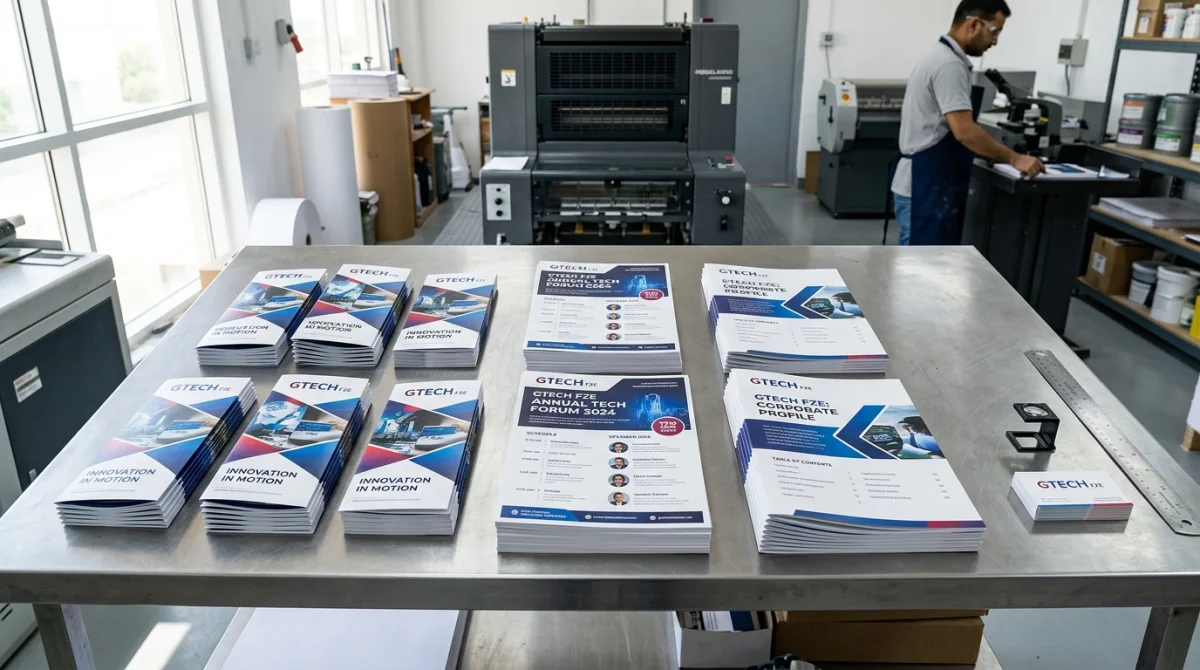
Commercial event collateral: Digital cut-sheet presses eliminate plate make-ready times and wet-ink oxidation drying delays, allowing UAE print shops to deliver finished conference brochures and marketing materials within hours of file approval. (Photo: Gtech FZE commercial production sample prints).
When Substrate and Format Shift the Equation
Historically, sheet size and media weight forced jobs onto offset presses even at short runs. Those technical barriers have narrowed dramatically:
Heavy Packaging Cardstock: Older digital presses struggled with board stocks above 300 gsm. Production engines in the Ricoh Pro range now routinely feed coated and uncoated folding boxboards up to 400–470 gsm using vacuum-assisted air-feed systems, making short-run retail packaging prototypes practical without an offset makeready.
Long Banner Sheets: Auto-duplexing banner sheets up to 700 mm and simplex up to 1,260 mm allow digital presses to print 6-panel roll-fold brochures, landscape A4 catalogs, and dust jackets that previously required large-format offset presses.
Variable Data Printing (VDP): If each page requires a unique barcode, QR code, delegate name, or personalized VIP invitation, offset is technically incapable of running the job without an offline digital overprint pass. Digital handles full-variable data at rated engine speed.
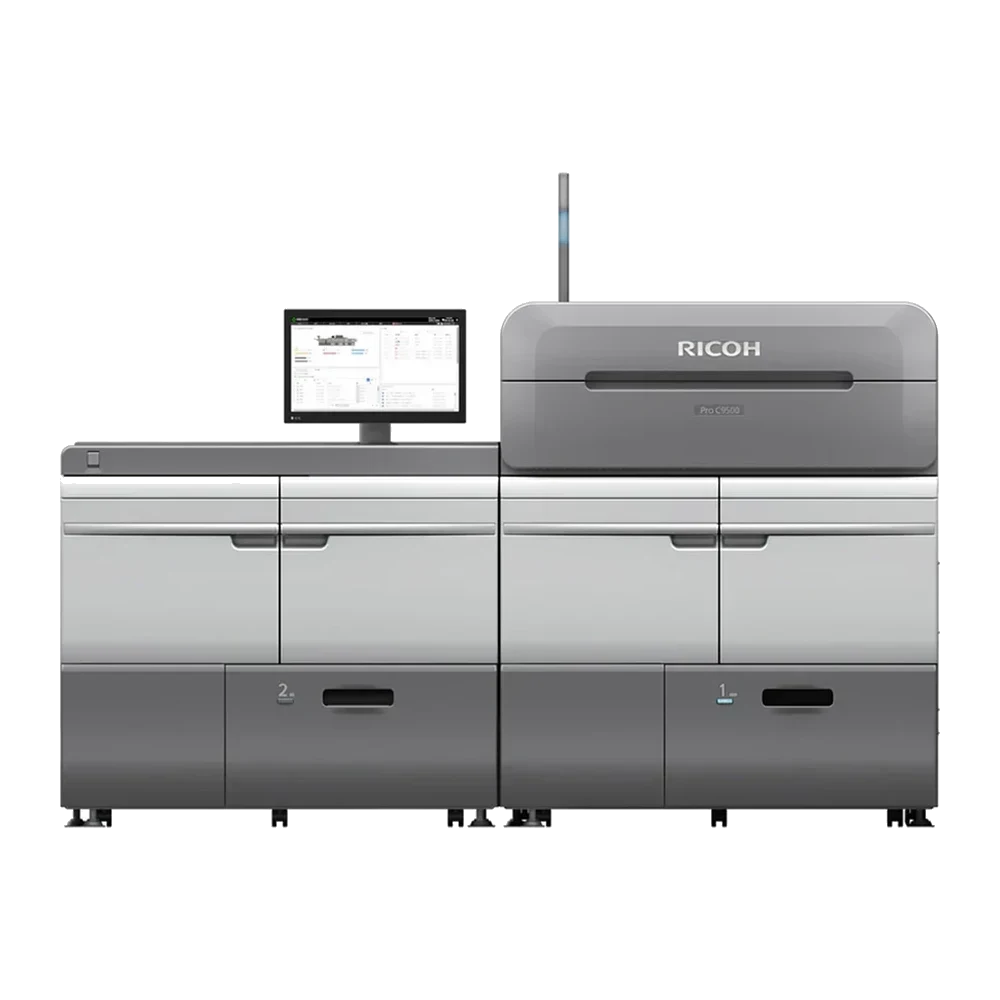
High-volume hardware: The Ricoh Pro C9500 cut-sheet color production press delivers rated speeds up to 135 ppm with vacuum-assisted air feeding for stocks up to 470 gsm and automated inline density calibration. (Equipment photo: Ricoh commercial production hardware).
The Modern Hybrid Print Shop
The most successful commercial print houses operating in the UAE do not treat digital and offset as opposing camps. They operate a hybrid floor: long-run packaging, bulk catalogues, and standard stationery run on heavy offset presses, while test runs, personalized print, short-run books, and emergency event turnarounds run on high-duty digital cut-sheet presses.
Understanding your exact cost per click, plate processing fees, and regional lead times allows you to quote accurately, preserve production margins, and deliver jobs on schedule. Explore our cut-sheet production press range or speak with our team for a tailored cost-per-page volume audit.
Disclaimer: Crossover volumes and cost estimates provided in this article are for general guidance and operational illustration only. Exact breakeven thresholds depend on specific machine configurations, local plate costs, paper stock grades, ink coverage percentages, and labor structures. Technical equipment capabilities are based on manufacturer specifications published at the time of writing. For certified production ratings and customized volume analyses, please consult directly with our technical sales team.
Questions
Frequently asked
What is the typical crossover run length between digital and offset printing?
For multi-page saddle-stitched booklets and annual reports, modern digital presses typically maintain a cost advantage up to approximately 1,200 to 1,800 finished copies because offset requires multiple plates and lengthy makeready. For flat, single-sheet A4 flyers, the crossover is lower—typically around 2,000 to 2,500 copies.
Why is digital printing preferred for Dubai exhibitions and rush events?
Digital presses require zero plate-making and zero drying time; toner-based sheets exit the fuser fully cured and ready for immediate trimming, folding, or binding. For tight 24- to 48-hour turnarounds common at DWTC and ADNEC expos, digital delivers same-day collateral that conventional offset oxidation inks cannot match.
Can modern digital presses print on heavy packaging cardstock?
Yes. Contemporary production presses like the Ricoh Pro C7500 and Pro C9500 utilize vacuum-assisted air-feed systems to reliably feed coated, uncoated, and textured boxboards up to 400–470 gsm, making short-run luxury packaging and carton mockups practical on digital equipment.
How does colour consistency compare between digital and offset?
Digital production presses equipped with inline spectrophotometers and EFI Fiery or Ricoh TotalFlow controllers automatically monitor and adjust toner density during the run, meeting rigorous ISO 12647-8 and Fogra colour standards with tighter consistency than manual offset ink-key adjustments.
Talk to us
Want this applied to your own setup?
We are an authorized Ricoh distributor holding stock at Jebel Ali, supporting installations across the UAE and exporting into the wider region. Tell us your volumes and we will tell you what fits.
Standard 4-colour digital printing has become a race to the bottom on price. A 5th colour station—running white, clear gloss, neon, or security red—lets UAE print houses charge premium rates for luxury packaging, VIP collateral, and high-margin short runs.
When an organization’s monthly external print invoices cross AED 15,000, outsourcing ceases to be a convenience and becomes an operational margin leak. Here is how UAE enterprises calculate the ROI of an in-house digital press.
The purchase price is the part of this decision people argue about and the part that matters least. Here is what the three-year number is actually made of, and the questions that change it.

 Authorized